Scheme Coordinator
Closing Date: 20 Feb 2026 4:00 pm
To apply please download the application form HERE.
Completed applications must be emailed to: applications@countrysideservices.com
Only application forms will be accepted for this post. Curriculum vitae will not be accepted.
Benefits:
– Competitive Salary
– Enhanced Holidays
– Occupational Sick Pay
– Pension Scheme
– Company Bonus Scheme
Contract Type: Full-Time
Scheme Coordinator – Farming for Sustainability – Knowledge (Themed Groups)
Countryside Services Ltd wishes to appoint a Scheme Coordinator to assist in delivery of the Farming for Sustainability – Knowledge (Themed Groups) Scheme throughout Northern Ireland.
The competition will also be used to compile a reserve list from which additional full-time or part-time staff may be appointed if required.
1. The Organisation:
Countryside Services Ltd (CSL) is wholly owned commercially independent subsidiary of the Ulster Farmers Union and provides a range of information, commercial and professional services to the farming and rural community. The Livestock Identification Division supplies livestock and other identification “tags” throughout the UK while the other services are delivered by the Rural Services Division which maintains a small team of technical and administration staff dedicated to delivery of these programmes.
CSL is a recognised Lantra training centre, and the Rural Services Division engages and manages a number of Training Associates to deliver a range of short skill and management courses. The Rural Services Team also works with other organisations in delivery of a number of programmes targeted at industry and individual development in the agricultural industry.
We have a long-term strategy to develop these activities and have recently been awarded the contract by the Department of Agriculture, Environment and Rural Affairs (DAERA) to support them in delivery of the Farming for Sustainability Scheme – Knowledge (2025 – 2030) Training and Themed Groups. The scheme is being managed through The College of Agriculture, Food & Rural Enterprise (CAFRE) but delivered by CSL
To service these programmes CSL now wishes to increase the core team of technical staff within the Rural Services Team by appointing a Scheme Coordinator to support the Contract Manager and Head of Rural Services in delivery of Lot 2 of the Farming for Sustainability – Knowledge (Themed Groups) Scheme.
2. SCHEME BACKGROUND
The Farming for Sustainability Scheme – Knowledge, aims to provide farmers and growers with a range of knowledge delivery methods to support the objectives of the SAP and support businesses to adapt to change. The Scheme is capable of reaching people across all farm businesses due to a range of intervention levels. It provides a structured pathway for Knowledge Transfer (KT) progression, meeting the needs of those requiring more complex decision making. This can be represented diagrammatically below:
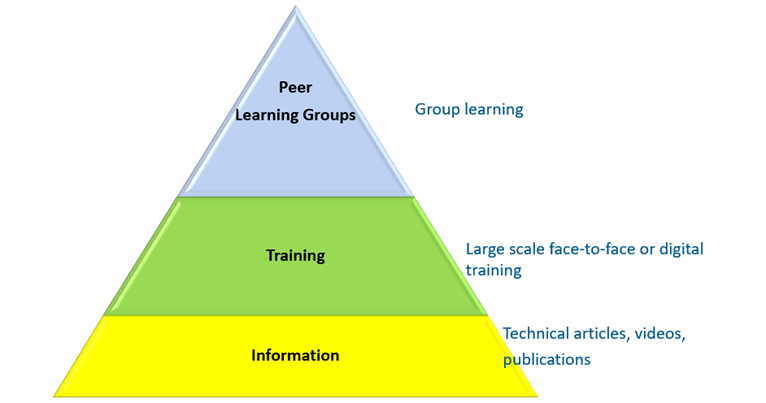
Due to the scheme several different KT layers incorporating varying depths of knowledge, there are a number of separate interventions that can be applied:
- Lower-level awareness information – available to all farmers in a variety of formats.
- Training – for training required by a significant number of farm businesses, DAERA will focus on delivery via e-learning courses. However, not all participants will have internet access, confidence or skills required to use this method, so additional face-to-face training is required.
- Peer to peer group learning:
- Business Sustainability Groups – longer term, whole farm approach, aimed at larger farm businesses.
- Themed Groups (TGs) – shorter term with a specific focus.
The Farming for Sustainability Scheme – Knowledge (2025 – 2030) Training and Themed Groups contract extends over 5 years and is being delivered and managed in 2 Lots:
- Lot 1 – Face-to-face training for groups of farmers
- Lot 2 – Themed peer-to-peer group facilitators
Lot 1 focuses on face-to-face training to individuals while Lot 2 seeks to deliver focused, high-quality peer-to-peer learning through Themed Groups (TGs) , providing farmers and growers with specialist facilitation and mentoring on priority topics identified by DAERA. TGs complement Business Sustainability Groups by offering shorter-term, topic-specific support, enabling participants to share experiences, access expert guidance, and apply tailored solutions directly to their farm enterprises. The Scheme Coordinator will primarily be working to on the day-to-day delivery of the Themed Peer-to-Peer Groups (Lot 2) although may on occasions be required to support the Contract Manager in delivery and monitoring of Lot 1 delivery.
INTRODUCTION TO LOT 1:
Lot 1 contract has two key aspects:
- Training Event Management– administration, venue booking, marketing and promotion, recruitment, managing bookings (via CAFRE’s online group booking system and telephone), helpdesk provision, event management on the day, and associated administration.
- Training Delivery– provision of suitably qualified trainers with the knowledge, expertise, and skills to deliver the specified training courses face-to-face to groups of participating farmers, aligned to existing CAFRE e-learning content.
Training courses to be delivered are:
- Soil Nutrient Health Scheme, including nutrient management planning. This course is fully developed and ready for immediate delivery
- Carbon Footprinting – understanding of carbon information and interpretation of farm data. This course is under development with the expectation of rollout within 3-6 months of appointment.
- Bovine Genetics – understanding genetic improvement and interpretation of data. This course is yet to be developed with the expectation of rollout within 12 months of appointment.
Training will be delivered to large groups (100+ attendees) and must replicate the e-learning version. All training content and materials are being provided by CAFRE. Some face-to-face training of smaller groups (25-49 attendees) may also be required, which will necessitate greater technical support from CSL due to increased discussion and questioning by the attendees. These groups may reflect specific enterprise types, e.g., pigs and arable enterprises which have a smaller number of farm businesses
INTRODUCTION TO LOT 2:
Themed Groups (TGs) are a new development from the previous Business Development Group (BDG) scheme which operated under the Northern Ireland Rural Development Programme and meets an identified need for shorter group duration with delivery focused on a specific topic/theme. The purpose of TGs is therefore to provide farm businesses with focused support and advice relating to specific themes and topics, therefore complementing BSGs which have a whole farm approach to sustainability and are aimed at larger, more intensive farms. TGs therefore meet a need for those farmers wishing to be part of a group learning experience but do not require a whole farm approach to address a specific issue. Knowledge delivered will be more in-depth compared to training in Lot 1 with some support offered to participants via mentoring.
General information relating to Themed Groups (TGs):
- TGs are short-term, topic specific peer-to-peer learning groups
- They are designed to provide farmers with technical knowledge and practical support focused on a specific topic.
- Groups will be recruited and formed by the CAFRE with CSL allocating facilitators to groups.
- These TGs complement Business Sustainability Groups (BSGs), which adopt a longer-term, whole-farm approach.
- Duration: 18-24 months per TG.
- Meetings: 5 and 12 meetings over the lifetime of the group (equivalent to 3-6 meetings per year, depending on theme).
- Groups size: Between 15 – 30 participants.
- Meetings will typically last 2-3 hours and will be held on members’ farms. They will take place at a time that suits participants, with a significant proportion expected to take place in the evening to accommodate those working off farm.
TGs focus on priority themes linked to DAERA policy objectives and are summarised below:
Themed Group | Indicative Content |
Suckler Cow Fertility | Reducing Calving Interval Calving heifers at 2 years old Understanding fertility KPIs Cow health |
Water Quality | Run-off risks Riparian buffers Manure management P-Balance |
Genetic Improvement* | Replacement Index Terminal Index Dairy Beef Index (DBI) Profitable Lifetime Index (PLI) |
* Differs from Bovine Genetic training in Lot 1 as assumes that participants have completed this training and group delivery focuses on using the information based on farmers own herds to make breeding decisions.
TGs differ from conventional training in that they provide opportunities for farmers facing similar issues to come together, share knowledge and experiences, and learn from one another in a structured group setting. Knowledge transfer is supported by an experienced/ qualified facilitator who is also responsible for mentoring to help participants apply learning to their own farm business/ enterprise.
There is no formal assessment of learning within TGs. However, participants are expected to contribute to group discussions, share information about their farm practices, and use lessons learned to improve farm performance.
Facilitation
Facilitation will be delivered on a face-to-face basis on group member’s farms. These host farmers will receive a hosting payment, which will be administered by CAFRE.
Facilitation will be provided by competent professionals qualified to at least honours (Grade 6) level and with significant relevant technical and facilitation / mentoring experience. They will be engaged by CSL and will guide group participants through a structured learning process to achieve the objectives of the group as identified by CAFRE. These facilitators will create a safe environment for participants to discuss topics and learn from each other, providing technical support to enhance learning and development. They will use a variety of questioning and leading techniques to involve all participants in the learning process and by getting to know participants over a period of time, they can be responsive to the needs of the participants and adapt delivery styles as appropriate.
Mentoring
As part of group support development, facilitators must also provide technical one-to-one guidance/mentoring to group members. This involves face-to-face farm visits and phone calls to farm businesses to discuss areas of improvement to meet the objectives of the Themed Group. Facilitation and mentoring will be delivered by the same person for each group.
The administration tasks within the contract will partly fall within the duties of the facilitator (e.g., attendance, risk assessments, progress reports) but with support from CSL administrative staff who will coordinate and monitor activities delivery on a scheme wide basis.
- ORGANISATIONAL POSITION
Job Title:
Scheme Co-ordinator
Key Purpose:
The Scheme Coordinator will have responsibility for the day to delivery of the Lot 2 contract of the Farming for Sustainability – Knowledge (Themed Groups) Scheme and monitoring this delivery to enable the Programme Manager and Contract Manager meet the reporting requirements of the CAFRE Contract Manager. This Lot 2 Themed Groups Scheme involves delivery of 8 facilitation sessions of Group Training per group and one-to-one mentoring of 1,750 scheme participants. The group facilitation and mentoring sessions will be delivered by an in-house group of Agriculture Group Facilitators and Associate Group Facilitators managed by the Scheme Co-ordinator.
Reports to:
The Scheme Co-ordinator is directly accountable to the Contract Manager in CSL for delivery of the Farming for Sustainability – Knowledge (Themed Groups) Scheme (Lots 1 and 2)
Manages:
While part of the Programme Manager’s Team delivering this Scheme, the Programme Manager will manage the small core administration team monitoring activities and the progress of the scheme. They will support the Programme Manager in supervising others involved in the delivery of the scheme, including Group Facilitators (Lot 2), Facilitators (Lot 1) and administration staff.
Core Activities:
- Arranging regular team meetings of those involved in delivering the TG (Lots 1 and 2) programme.
- Arranging training of the Facilitators and Associates as provided by CAFRE e.g., CIVICA and Risk Assessment training
- Arranging training by external providers as necessary – e.g., technical updates and facilitation skills. This will included training needs identified in annual performance review with all staff by their respective manager.
- Ensuring that all those delivering the Scheme meet security and safeguarding requirements.
- Assignment of Group Facilitators to individual Groups as agreed with Programme Manager.
- Arranging monitoring of Group progress including provision and uplifting to CIVICA of the required information including insurance, risk assessments, TB clearance, member attendance and evaluations.
- Ensuring Agriculture Group Facilitators and Group Facilitation Associates have the equipment and resources required, including AV presentation equipment, PPE for members, signage biosecurity equipment and are competent in its use.
- Ensuring that Programme Manager and Contract Manager are provided with the monitoring reports as required by the CAFRE Contract Manager.
- Attend and record monthly contract management meetings with CAFRE.
- Scrutinise claims from facilitators and invoices from Group Facilitation Associates and recommend action to Programme Manager.
Key Purpose of the role:
To contribute to the programmes delivered by CSL Rural Services Division.
Reports to:
Rural Services Contract Manager, CSL
Manages:
While the Project Officers will be working as part of the delivery team for the Rural Services programmes a Project Officer may on occasion be required to supervise others involved in the delivery of the scheme, for example, Training Associates.
Essential Criteria:
(a) Qualifications and Experience:
Applicants must have –
- A third level qualification in agriculture or a closely related discipline
- GCSE or equivalent English and Maths, grade C or higher.
- Experience of working in the agricultural/rural community in either a paid or voluntary capacity
(b) Abilities and Skills:
Applicants will be expected to provide evidence, in their application and/or at interview, of the following well developed skills and abilities:
- Excellent communication and interpersonal skills
- Proven Organisational Skills
- IT competence – with experience of using spreadsheets, MS Office, internet and e-mail
- Ability to work using own initiative
- Ability to work under pressure whilst meeting standards and deadlines
Desirable:
Possession of qualifications or experience in one or more of the following areas may be an advantage:
- Qualification to at least degree level
- Experience of agriculture or rural development scheme administration
- Knowledge of farm machinery and equipment supply
NOTE:
i) The post holders will be required to travel throughout Northern Ireland on a regular basis and must be available to work occasional evenings and weekends as required.
A valid driving licence and access to a car, or some means of transport which allows the post holder to meet the demands of the post in full are essential.
ii) As part of a small team within Countryside Services Ltd the post holder will be expected to contribute, as required, to the wider work of the organisation and show flexibility in line with the needs of the contracts and the organisation.
- Terms and Conditions
Location:
Countryside Services Ltd, 97 Moy Road, Dungannon, BT71 7DX
Contract Duration:
Full-time contract
Hours Of Work:
37.5 hours per week. The TG scheme is expected to involve fluctuating workloads, including working additional hours at peak periods. Such additional hours including evening work will be remunerated on a time off in lieu basis.
Salary Scale:
A basic salary in the range £35,000 to £40,000. Starting position on the pay scale is dependent on experience and qualifications.
Travel Expenses:
Reasonable travel expenses are paid according to a standard CSL staff rate.
Pension:
Members of staff will be auto-enrolled into a pension scheme upon the successful completion of their 3-month probationary period.
Sickness/ Absence:
You will be paid sick pay according to the rules and regulations of the Company’s Sick Pay Scheme and the Statutory Sick Pay Scheme, subject to compliance with the Company’s Sickness/Absence Notification Procedure.
During periods of sickness absence CSL reserves the right to require you to be examined by a Company nominated doctor, as it considers necessary.
Notice Period:
After one month’s service, you will be required to give six months’ notice in writing of your intention to terminate your employment.
Note:
CSL may decide to call for assessment and interview only those applicants who appear from the information provided to be most suitable in terms of relevant experience. Applicants should therefore ensure that their application form contains all the information which they consider relevant to the specified criteria.
This job description is not intended to be exhaustive, and flexibility in your approach to your role is essential. We reserve the right to amend or change this job description from time to time to suit the changing needs of the role and the business and you agree to accept any such changes.